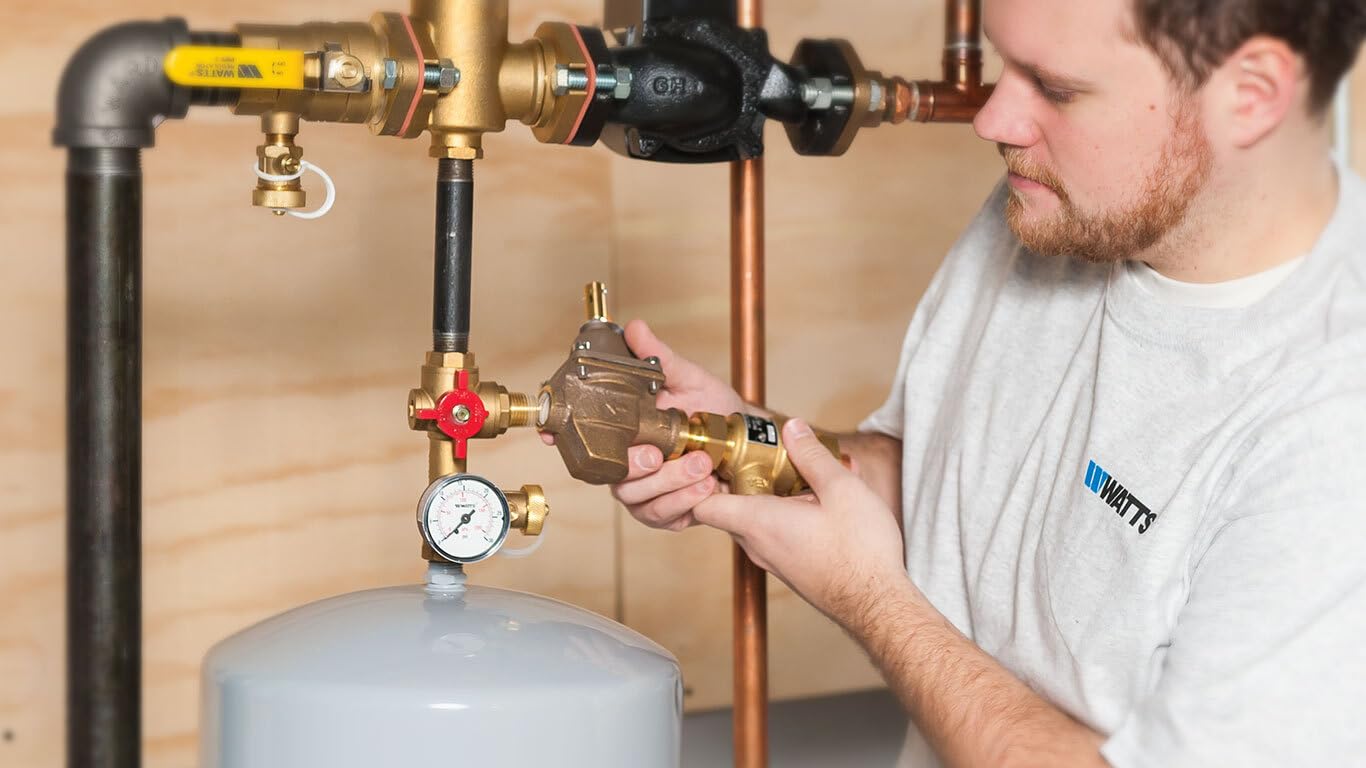
When your water heater warms cold water from 50°F to 120°F, that water physically expands — it gets slightly bigger in volume. In older plumbing, the extra volume would simply push back toward the municipal main, no harm done. But most homes built or replumbed in the past two decades have a check valve or pressure-reducing valve (PRV) at the water meter — a one-way device that prevents water from flowing backward out of your house. That’s great for water quality and pressure control, but it creates what plumbers call a closed system: the expanded water has nowhere to go. Pressure builds. Over time, that cycling pressure stresses your water heater’s tank, your fixtures, and your appliances. A thermal expansion tank — a small pressurized vessel, typically the size of a soccer ball, installed on the cold-water supply line near the heater — absorbs that expansion safely. It costs $30–$80 for the tank itself, less than an hour of labor to install, and it’s required by code in most U.S. jurisdictions the moment a closed system is present. Most homeowners have never heard of it. Many water heaters have been quietly voiding their own warranties because of it.
| EDITOR'S PICKWATTS WATER TECHNOLOGIES GIDDS-… | Mid-tier[TT FLEX Potable Thermal Expansi…](https://www.amazon.com/dp/B09N8TNBVN?tag=greenflower20-20) | Budget pickPotable Thermal Expansion Tank… | |
|---|---|---|---|
| Capacity | 4.5 Gallon | 2.1 Gallon | 2.1 Gallon |
| Connection Size | — | 3/4 Inch MNPT | 3/4" MNPT |
| Material | Stainless Steel Nipple | — | — |
| Lead-Free | Lead Free | — | — |
| Price | $74.66 | $39.99 | $38.88 |
| See on Amazon → | See on Amazon → | See on Amazon → |
Why Closed Systems Are Now the Default — and Why That Changed Everything
Twenty years ago, most residential plumbing was effectively an open system: water could flow freely in both directions between your home and the utility main. Thermal expansion self-relieved back into the street without incident. Three converging changes flipped that baseline.
1. Backflow prevention became standard code. The 2021 International Plumbing Code (IPC), Section 607.3, and the 2021 International Residential Code (IRC), Section P2903.4 both require thermal expansion control whenever a backflow preventer, check valve, or PRV creates a closed system on the supply side. Municipalities adopted these provisions in waves through the 2000s and 2010s. If your meter was set or replaced after roughly 2005 in most urban and suburban jurisdictions, you almost certainly have a check valve built into it. Per the IPC commentary, this applies to both new construction and any regulated replacement installation — meaning a new water heater permit can trigger the requirement retroactively.
2. Pressure-reducing valves became nearly universal. PRVs protect homes from utility-side pressure spikes and are required when street pressure exceeds 80 psi in most codes. A PRV inherently creates a closed system because its internal check seat prevents backflow. According to Watts Water Technologies’ Expansion Tank Sizing and Selection Guide, a properly functioning PRV is one of the most common unrecognized causes of closed-system conditions in existing homes.
3. High-efficiency water heaters run hotter, faster. Condensing tankless units and heat pump water heaters (HPWHs) cycle through larger temperature differentials than old resistance-element tanks. A heat pump unit recovering from a heavy draw may push recovery water through a 50–60°F temperature rise in a compressed time window. More delta-T, more expansion volume, more pressure stress on the system if there’s no relief path.
The result: the “I’ve had this house for 20 years with no problems” framing is often technically wrong. The problems are slow, cumulative, and mostly invisible until they’re not.
What Actually Happens Without One — and What It Costs You
The failure mode is worth understanding precisely because it’s gradual and then sudden.
Thermal shock cycling. Every time the heater fires, pressure in a closed system rises — often to 150 psi or beyond from a resting 60–80 psi. The tank’s glass lining and anode rod experience micro-stress with each cycle. This is one of the most frequently cited causes of premature tank failure in plumbing trade literature. Plumbing & Mechanical Magazine’s coverage of closed-system dynamics notes that tank manufacturers began adding closed-system exclusions to warranties in large numbers once PRVs proliferated — a response to warranty claims they could document as pressure-related.
T&P valve discharge. Your water heater already has a temperature and pressure relief valve (T&P valve) — a safety device that opens and discharges water if pressure or temperature exceeds safe limits (typically 150 psi / 210°F). In a closed system without an expansion tank, the T&P valve becomes the expansion relief path by default. It’s not designed for this duty cycle. Repeated small discharges corrode the valve seat; a valve that weeps habitually may fail to reseat properly, creating a drip — or eventually fail to open in a genuine overpressure event. This Old House’s installation guidance on thermal expansion tanks explicitly names repeated T&P valve dripping as the primary symptom that a closed-system problem already exists.
Fixture and appliance wear. Elevated cyclic pressure stresses washing machine hoses, icemaker lines, and fixture cartridges. Owners in long-run reviews on plumbing forums and contractor Q&A platforms consistently report that homes with documented chronic high pressure see significantly higher rates of fixture cartridge failure and supply line failures.
The warranty angle. This is the practitioner-level detail that matters for a renovation or replacement project: major manufacturers including Rheem, A.O. Smith, and Bradford White include explicit closed-system language in their installation manuals. A.O. Smith’s residential installation documentation for current tank and heat pump units states that a thermal expansion tank is required when a closed system exists, and that failure to install one voids the warranty coverage for pressure-related damage. If you’re specifying a $1,200 Rheem Prestige Hybrid or a $900 Navien tankless and skipping the $50 expansion tank, you’ve created a warranty gap on the expensive equipment.
Sizing the Tank: The Math Is Simpler Than It Looks
Expansion tank sizing depends on three variables: the water heater’s storage capacity, the system’s supply pressure, and the tank’s pre-charge pressure (the air pressure inside the tank’s bladder at rest). Here’s the framework.
By the numbers — typical residential sizing:
| Water Heater Size | Supply Pressure | Expansion Tank |
|---|---|---|
| 40–50 gallon | 40–60 psi | 2-gallon tank (Watts ET-5, Amtrol Therm-X-Trol ST-5) |
| 50–80 gallon | 60–80 psi | 4.4-gallon tank (Watts ET-15, Amtrol ST-12) |
| 80 gallon+ / multiple heaters | 80 psi+ | Size up; consult Watts or Amtrol sizing charts |
The pre-charge pressure of the expansion tank’s bladder must match your cold-water supply pressure — not the hot-side operating pressure. This is a common installation error. If your PRV is set to 65 psi and the expansion tank arrives from the factory pre-charged to 40 psi (common default), you need to adjust the tank’s air valve with a standard tire gauge and pump before installation. According to the Watts expansion tank sizing guide, a mismatched pre-charge is functionally equivalent to having an undersized or non-functional tank — the bladder is already partially collapsed against the supply pressure before any thermal expansion occurs.
Sizing calculators are published by Watts Water Technologies and Amtrol (now part of Worthington Industries) and are available on both manufacturers’ technical resources pages. For standard residential jobs, the 2-gallon tank covers the overwhelming majority of 40–80 gallon installations at normal residential supply pressures. For tankless systems, where the storage volume is zero but the supply plumbing itself holds water, the calculation is different — expansion volume is lower, but some jurisdictions still require an expansion tank on the supply side. Verify with your AHJ (Authority Having Jurisdiction — the local inspector or building department that enforces code).
Installation Essentials and Common Code Triggers
Installation is within reach of a competent DIYer in most jurisdictions, but permits are required in many — and a water heater replacement permit that gets inspected may flag a missing expansion tank even on a system that has been code-deficient for years.
Where it goes. The expansion tank connects to the cold-water supply line, typically within 18 inches of the water heater. It can be installed in any orientation — horizontal, vertical, upside down — though vertical with the connection down is slightly preferred for bladder longevity in most manufacturers’ installation guidance. Use a dielectric union if connecting a steel tank to copper supply lines to prevent galvanic corrosion at the joint.
What triggers the permit inspection:
- Pulling a water heater replacement permit (most common trigger)
- Adding a PRV (immediate closed-system creation)
- A meter replacement by the utility that includes backflow prevention
- Any new construction or addition requiring a plumbing inspection
Energy.gov’s water heater installation and safety guidance recommends verifying local code adoption status before any water heater replacement, specifically because the expansion tank requirement is one of the most frequently missed items in DIY installations.
One thing installers get wrong. The expansion tank should be installed on the cold-water supply line between the PRV (or check valve) and the water heater — not between the water heater and the fixtures. Installing it on the wrong side of the check valve defeats the entire purpose, because the tank would then be on the open side of the system and wouldn’t absorb closed-system pressure buildup. This Old House’s installation walkthrough shows the correct positioning clearly in their step-by-step guidance.
The Decision Rule: If X, Then Y
This is the cleanest way to apply everything above to a current project:
If you’re replacing a water heater and pulling a permit → assume a closed system exists until proven otherwise. Install a correctly sized and pre-charged expansion tank as part of the job. The marginal cost ($40–$80 part, 30–45 minutes of labor) is trivial against the warranty and code risk on a $400–$2,000+ heater.
If you have a PRV at the meter or a utility-installed check valve → you have a closed system by definition. An expansion tank is not optional; it’s required by the IPC and IRC as adopted in your jurisdiction.
If your T&P valve drips occasionally and you haven’t changed anything → this is the closed-system pressure signature. Don’t replace just the T&P valve. Diagnose the system pressure, confirm closed-system conditions, and install the expansion tank first. Then evaluate whether the T&P valve itself needs replacement.
If you’re specifying a high-efficiency unit (heat pump, condensing tankless) in a renovation → build the expansion tank into the spec and the estimate from day one. The warranty language from Rheem, A.O. Smith, and Bradford White makes this non-negotiable on paper. Leaving it out creates liability exposure on a five-figure system installation.
If supply pressure at the PRV is above 65 psi → verify tank pre-charge matches, and consider whether a 4.4-gallon tank is more appropriate than the 2-gallon default. The extra $15–$20 for the larger tank is cheap insurance against undersizing.
The expansion tank is one of those components that experienced plumbers install reflexively and first-time homeowners never hear about — until there’s a dripping T&P valve, a failed tank at year seven, or a failed inspection that delays a renovation close. Getting it right is straightforward once you know it exists.