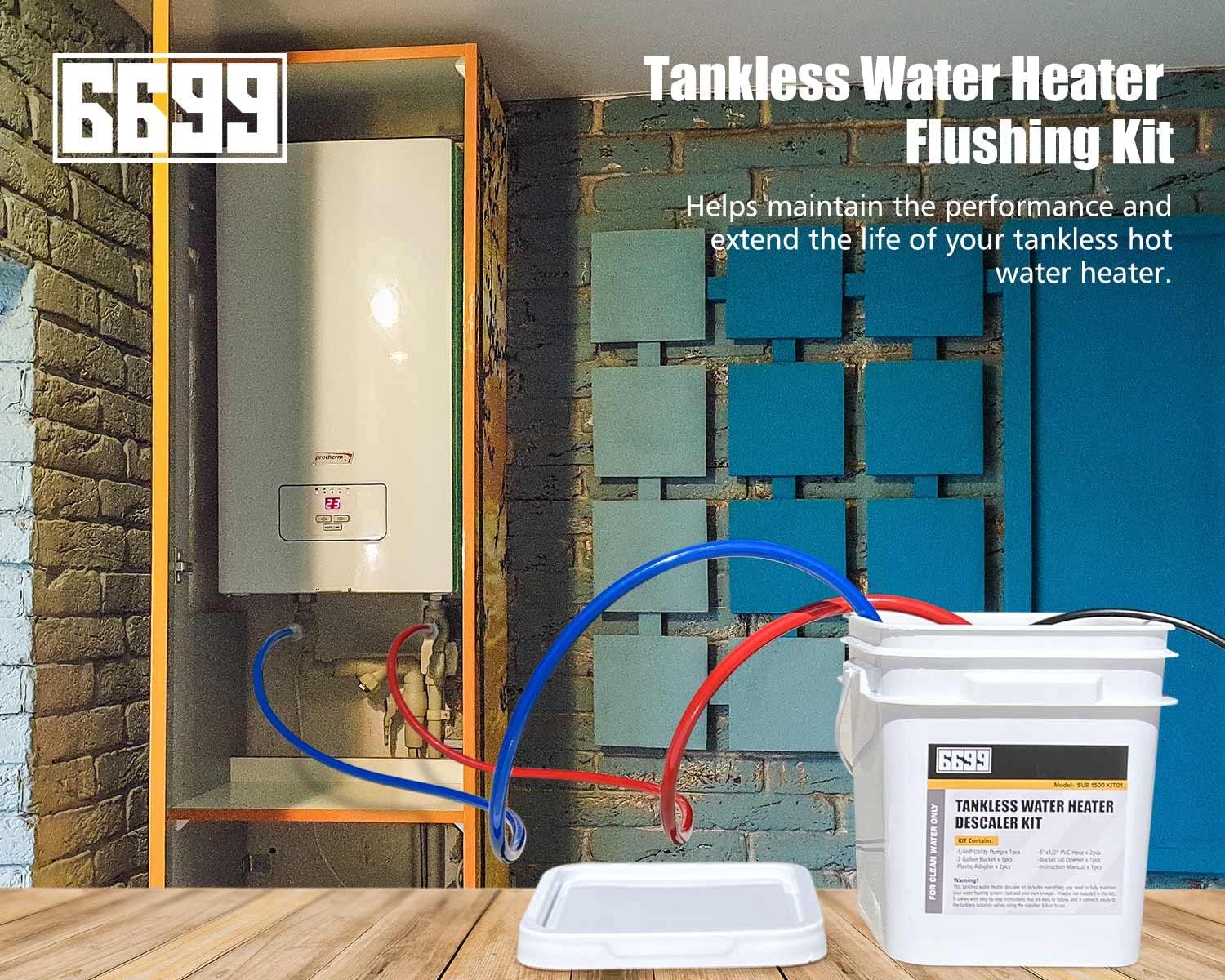
A tankless water heater — sometimes called an on-demand heater — heats water only when you turn on a tap, rather than storing a tank of pre-heated water. That design is efficient and space-saving, but it has one quiet vulnerability: the heat exchanger (the coiled metal core where cold water picks up heat) is constantly exposed to the full mineral load of your incoming water supply. Over time, calcium and magnesium dissolved in that water deposit on the exchanger walls as a hard, chalky crust called scale. A little scale is normal. Enough scale and your unit works harder, heats less effectively, and eventually fails well before its time. The good news: a single annual maintenance session — a flush and descale — clears that buildup and keeps your investment performing like new. This guide walks through exactly how to do it, when it matters most, and how to make the right call for your specific setup.
Why Scale Is a Bigger Problem in Tankless Units Than in Tank Heaters
In a traditional storage tank, scale builds slowly across a large surface area and tends to settle at the bottom. Annoying, yes — but the tank’s thermal mass buffers some of the efficiency loss. A tankless unit has no such buffer. The heat exchanger is a compact, high-surface-area coil designed to transfer enormous amounts of heat in a very short time. When scale coats that surface — even a thin layer — the math turns against you quickly.
Per the U.S. Department of Energy’s overview of demand-type water heaters, scale buildup of as little as 1/16 inch on a heat exchanger surface can reduce heat transfer efficiency by 10–15%. At 3/16 inch — achievable in moderately hard water within two to three years without maintenance — that efficiency loss can exceed 25%. You’re burning more gas or electricity to deliver the same hot water, and the exchanger itself is running hotter than it was designed to, accelerating metal fatigue.
Rinnai’s residential service manual flags a second problem specific to tankless design: restricted flow. As scale narrows the exchanger passages, flow sensors detect less water movement and the unit may reduce its firing rate or trigger error codes (Rinnai’s LC code — “scale detection” — is one of the most common service flags owners report on RUR and RU series units). Navien’s NPE-A2 Series manual similarly documents a dedicated scale detection alert tied to heat exchanger pressure differential. In short: the unit is telling you it needs a flush before the damage becomes structural.
By the numbers:
| Water Hardness | Scale Risk Level | Recommended Flush Frequency |
|---|---|---|
| < 7 gpg (soft) | Low | Every 2 years |
| 7–14 gpg (moderate) | Moderate | Annually |
| > 14 gpg (hard) | High | Every 6–12 months |
gpg = grains per gallon. Your local water utility’s annual water quality report lists hardness; many municipalities post this on their websites. A basic water hardness test strip (~$10 at hardware stores) also works.
What You Need: Tools, Materials, and a Realistic Time Budget
This is a job most mechanically comfortable homeowners handle themselves. A licensed plumber or HVAC tech can do it in under an hour if you’d rather outsource, but the parts cost alone makes DIY compelling.
Core kit:
- Submersible pump (small utility pump, typically 1/6 HP or less — a sump pump is too aggressive)
- 5-gallon bucket
- Two washing machine hoses (3/4-inch, about 4–6 feet each) — most tankless units have 3/4-inch service port connections
- Food-grade white vinegar (4–6 gallons) OR a dedicated tankless descaling solution such as Rectorseal Calci-Free or Fernox DS-40
The vinegar-vs.-descaler question comes up constantly. Popular Mechanics’ descaling guide notes that undiluted white vinegar (5% acidity) is effective for moderate scale in units flushed annually but may require a longer soak (45–90 minutes) compared to 30–45 minutes with a commercial descaler. For units that haven’t been serviced in two or more years, or for hard-water regions above 14 gpg, a purpose-formulated descaler typically clears stubborn deposits faster and more completely. The commercial solutions also typically include a neutralizing step that makes disposal easier — diluted vinegar can generally go down the drain, but check your local sewer authority’s guidance.
Time: Plan for 90 minutes start to finish for a first-time flush. Once you’ve done it once, 45–60 minutes is realistic.
Step-by-Step: The Annual Flush and Descale Routine
Step 1: Shut down the unit properly.
Turn the unit to its service or maintenance mode if one exists (Rinnai and Navien both have this — consult your model’s manual). For gas units, set the gas valve to the off position. For electric units, kill the breaker. Do NOT skip this — circulating descaler through a firing heat exchanger can damage seals.
Close the cold water inlet valve (this is the valve on the cold water supply line feeding the unit). Close the hot water outlet valve (the line leaving the unit toward your fixtures). This isolates the unit from your plumbing — your household cold supply stays live; the unit is just isolated.
Step 2: Connect the service ports.
Most modern tankless units — Rinnai RUR/RU series, Navien NPE series, A.O. Smith ATI series, Noritz EZ series — have dedicated service ports (also called isolation valve service ports or flush ports) built into the inlet and outlet valves. They typically look like hose bib connections. Connect one hose from the cold inlet service port to the pump outlet submerged in your bucket. Connect the second hose from the hot outlet service port back into the bucket — this is your return line. The circuit runs: bucket → pump → cold inlet port → through the heat exchanger → hot outlet port → back to bucket. A closed loop.
Step 3: Fill and circulate.
Fill the bucket with your descaling solution. Plug in the pump and run the loop for the time recommended by your descaler manufacturer — typically 45 minutes for commercial solution, up to 90 minutes for vinegar. This Old House’s flush walkthrough emphasizes keeping the pump submerged throughout; if the solution level drops (absorbed into the exchanger or evaporates slightly), top it off.
During circulation, inspect the exterior of the unit: look for corrosion at connections, check that venting hasn’t shifted (for gas units), and check the air filter screen if your model has one (Navien NPE units have a small cold-water inlet filter screen that should be cleaned or replaced annually — it’s a 5-minute job while you’re waiting).
Step 4: Flush with clean water.
Drain the bucket, refill with clean fresh water, and run the pump for 10–15 minutes to rinse the exchanger. This clears any residual descaler chemistry from the heat exchanger passages.
Step 5: Reconnect and restart.
Disconnect the hoses, reinstall any service port caps, and reopen the cold inlet and hot outlet valves in that order. Restore gas or power. Run a hot tap inside the house to purge air from the system, then confirm the unit fires and reaches set temperature normally.
Bonus step for gas units: clean the inlet filter screen. Most gas tankless units have a small filter screen at the cold water inlet that traps sediment. It’s typically a 5-minute removal-and-rinse job, but it’s consistently underperformed in owner maintenance surveys — Rinnai’s service documentation notes it as a common source of low-flow complaints that get misdiagnosed as scale issues.
Decision Framework: When to DIY, When to Call a Tech
The flush routine above is genuinely within reach for a handy homeowner or property manager. But several scenarios change the calculus:
If X, then Y:
-
If your unit is still under manufacturer warranty and hasn’t been serviced in 2+ years: Call a licensed tech. Navien and Rinnai both require documented annual maintenance as a condition of warranty claims in most scenarios. A technician’s service record protects you if you ever need to invoke the warranty. One service call ($80–$150 typically in 2026) is cheap insurance on a $900–$1,400 unit.
-
If your unit is throwing error codes (Rinnai LC, Navien 003E, Noritz 14): These are scale/flow codes. The flush described above is the correct first response, but if the code persists post-flush, you likely have a secondary issue — possibly a stuck flow sensor, a partially failed heat exchanger, or a gas valve problem. At that point, a diagnostic visit is the right call.
-
If you’re managing 3+ units at a property: Systematize it. A property manager running a boutique hotel or multi-unit residential building should schedule all units on a rolling annual calendar, maintain a log, and — if the units are commercial-grade (Bradford White ICON System, Rinnai CX series) — confirm the descale solution you’re using is compatible with the NSF-rated components. Rinnai’s commercial CX series documentation specifies approved maintenance procedures; deviating from them can void commercial certifications relevant to food-service settings.
-
If your water hardness is above 14 gpg: Consider supplementing the annual flush with a whole-home water softener or a phosphate-based inline scale inhibitor on the cold feed to the unit. The flush routine still matters, but reducing the incoming mineral load cuts scale accumulation between services significantly. Per the U.S. Department of Energy’s guidance on water heating efficiency, addressing source water hardness can extend heat exchanger life by years.
-
If you have a Stiebel Eltron Tempra Plus or another electric tankless unit: The descale routine is essentially identical, but the risk profile is different — there’s no venting or gas valve to inspect, and the heating elements in electric units are more directly accessible in some models. Stiebel Eltron’s owner documentation covers element inspection as part of the annual service; include it while you have the unit isolated.
The Investment Case in Plain Numbers
A replacement heat exchanger for a mid-tier tankless unit (Rinnai RUR199, Navien NPE-240A2) runs $400–$700 in parts, plus $150–$300 in labor — and that’s assuming the rest of the unit is serviceable. A full unit replacement is $900–$1,400 installed. An annual flush costs you $15–$25 in vinegar or descaler and 90 minutes of time. Even at two flushes per year in a hard-water area, the math is not close.
Tankless units are rated for 20-year service lives in published manufacturer specifications — roughly double a standard tank heater — but that figure assumes the maintenance schedule is followed. Owners in aggregated long-run reviews consistently note that units flushed annually perform reliably well into their second decade; units that weren’t maintained tend to show heat exchanger degradation and error-code frequency within 7–10 years. The annual flush is the single highest-return maintenance action available for this category of equipment. Do it, document it, and your unit will almost certainly outlast your ownership of the property.