If you’ve ever stood at a campsite faucet waiting for warm water that never quite showed up — or watched your trailer’s 12-volt house battery gauge drop faster than expected — you’ve already bumped into the core problem this article solves. An RV tankless water heater works the same fundamental way as a home tankless unit: cold water flows in, a burner or heating element fires on demand, and hot water comes out — no storage tank, no standby heat loss. The difference is that every design decision on an RV unit has to account for limited propane supply, a battery system measured in amp-hours rather than unlimited grid power, and the physical reality that your “utility room” is a compartment smaller than a microwave cabinet. Get the sizing wrong and you either run cold mid-shower or you drain your battery bank trying to power the igniter and control board. This guide walks through how to size BTU output to your flow-rate demands, how to calculate 12V draw against your battery capacity, and which units consistently earn owner approval across each use case.
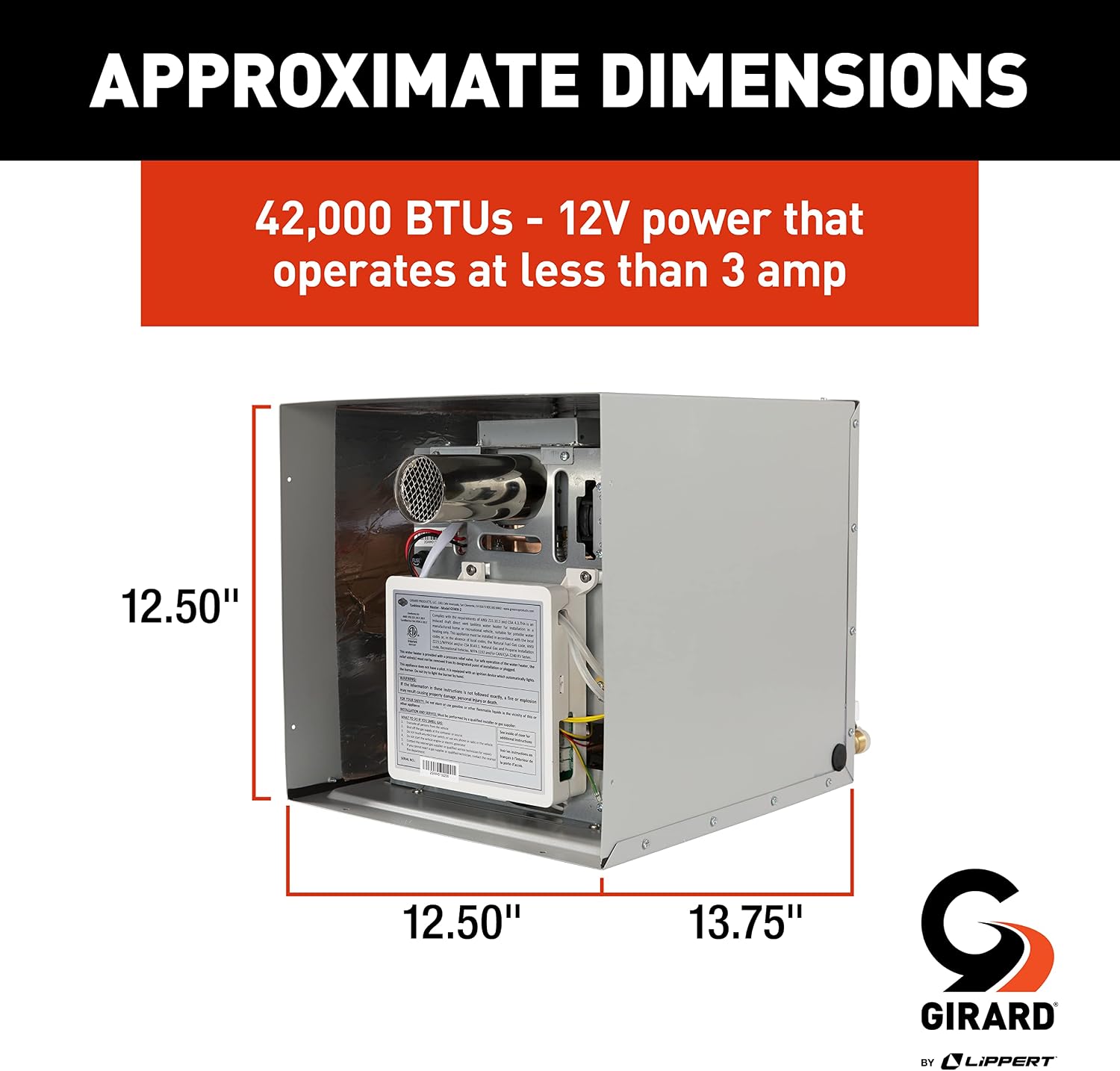
| EDITOR'S PICK[GIRARD Tankless RV Water Heater](https://www.amazon.com/dp/B019BWN8E2?tag=greenflower20-20) | Mid-tierKINGRVER [KINGRVER XT48 Tankless](https://www.amazon.com/dp/B0CFZMYDDX?tag=greenflower20-20)… | Budget pick[CAMPLUX 5L Portable Tankless Wa](https://www.amazon.com/dp/B01CJPU6JI?tag=greenflower20-20)… | |
|---|---|---|---|
| BTU Output | 42000 | — | — |
| Power (12V DC) | ✓ | ✓ | — |
| Flow Rate | — | — | 1.32 GPM |
| Propane Type | — | — | Outdoor Propane |
| Digital Control | ✓ | — | — |
| Freeze Protection | ✓ | — | — |
| Price | $755.51 | $299.99 | $159.99 |
| See on Amazon → | See on Amazon → | See on Amazon → |
Why BTU Output Is the Number That Matters First
BTU — British Thermal Unit — is the standard measure of heat energy. In tankless water heater terms, it tells you how fast the unit can raise incoming cold water to your target temperature. The practical output you care about is expressed as gallons per minute (GPM) at a given temperature rise (ΔT). If your groundwater comes in at 55°F and you want 105°F at the showerhead, that’s a 50°F rise. The higher your BTU input rating, the more GPM you can heat across that rise.
The U.S. Department of Energy’s overview of demand-type water heaters (energy.gov) frames it clearly: flow rate is the primary sizing variable for any tankless system, and the design flow rate should reflect simultaneous draw — not peak single-fixture use. In an RV that matters because “simultaneous draw” is usually just one shower, but in a Class A coach or a converted bus with two bathrooms, it can be a shower plus a galley sink running at the same time.
The sizing math in plain terms:
Most RV-duty propane tankless units on the market in 2026 fall into three BTU tiers:
| BTU Input | Approximate GPM at 50°F Rise | Typical Application |
|---|---|---|
| 42,000–52,000 BTU | 1.5–2.0 GPM | Solo or couple, one fixture at a time |
| 52,000–68,000 BTU | 2.0–2.8 GPM | Small family, one shower + modest sink |
| 70,000–90,000 BTU | 2.8–4.0 GPM | Larger rigs, two-bath coaches, extended families |
Source: Published specification sheets from Rinnai, Suburban Manufacturing, and Camplux product documentation, cross-referenced against the This Old House tankless buying guide framework for sizing methodology.
A standard RV showerhead flows at roughly 1.5–2.5 GPM (low-flow fixtures are common in rigs to conserve water). A kitchen faucet adds another 0.5–1.5 GPM. If you’re running both simultaneously, you need a unit that can handle 2.0–4.0 GPM at your local groundwater temperature rise. If you’re in the American Southwest in summer with 75°F incoming water, your required ΔT drops to around 30°F and even a mid-tier unit can handle simultaneous draw. If you’re dry-camping in Montana in October with 42°F groundwater and you want a real hot shower, a 42,000 BTU unit will frustrate you.
The tradeoff is weight and physical size. Higher-BTU RV units are heavier and draw more propane, which matters when you’re balancing payload and tank range. This Old House’s tankless buying guide notes that BTU-to-GPM efficiency varies not just by burner size but by heat exchanger design — a unit with a quality copper exchanger will extract more usable heat per BTU than a cheaper steel design running the same input rating.
12V Power Draw: The Constraint Most Buyers Miss
Unlike residential tankless units that either run on 120V AC (electric) or use AC to power ignition and controls (gas), the best RV tankless heaters are designed to run ignition, modulating gas valves, and control boards entirely off 12V DC — your house battery system. This sounds like a small detail until you’re boondocking three nights off-grid and you realize the igniter is cycling every shower, every dish rinse, every hand wash.
The numbers that matter for off-grid planning:
A typical RV propane tankless unit draws between 0.6 and 3.5 amps at 12V DC during operation. At the low end (Camplux and similar compact units), the draw is essentially negligible against a properly sized house bank. At the higher end — units with modulating controls, digital displays, and freeze-protection functions like the Suburban SW series — you’re pulling closer to 2–3.5A continuously while the heater runs.
Here’s the real-world math: if your household battery bank is 200 amp-hours (Ah) of usable capacity (a common AGM setup in mid-range travel trailers), and your water heater draws 2A for roughly 15 minutes of shower time per day:
- 2A × 0.25 hours = 0.5 Ah per shower
- That’s less than 1% of your 200 Ah bank per day
In isolation, the water heater’s 12V draw is almost never the problem. The problem emerges when buyers spec a heater with a continuous 3.5A parasitic draw for freeze protection or a standby keep-warm function, and that runs all night at 34°F ambient. Eight hours × 3.5A = 28 Ah — that’s 14% of a 200 Ah bank before you’ve made breakfast. Popular Mechanics’ RV coverage flags exactly this scenario: freeze-protection modes on electronic-control units are the hidden drain that surprises owners in their first cold-season trip.
The decision rule here is straightforward: If you primarily camp in moderate climates and have shore power or solar on most nights, a unit with richer electronics and freeze protection is worth the draw. If you’re a committed boondocker with a modest battery bank and no solar, prioritize a unit with minimal standby draw and manual freeze-drain capability — simpler is more reliable under those conditions.
Matching Unit to Rig: The Three Decision Scenarios
Scenario 1: Compact trailer or solo use, budget-conscious
For a single-axle travel trailer, a van conversion, or a couple doing weekend trips, a unit in the 42,000–52,000 BTU range with sub-1A standby draw covers the demand. Camplux’s CB-series portable propane units are widely cited in owner reviews for doing exactly this job reliably. Published spec sheets put the CB-52 at approximately 52,000 BTU with a 1.32 GPM flow trigger, which means it lights reliably at common low-flow RV showerhead outputs. Owners consistently report that the dial-control simplicity — no digital board, no complex modulation — means there’s very little to fail on a weekend trip.
The tradeoff: no freeze protection, no remote or app control, limited temperature precision. You dial and adjust. For a weekend warrior, that’s fine. For someone spending November in a national forest, it’s a liability.
Scenario 2: Mid-range fifth wheel or Class C, one or two occupants year-round
This is where the Suburban SW6DE (6-gallon tank/direct-spark) and SW10DE have historically lived, but the segment is shifting toward true tankless as buyers recognize the efficiency gains the U.S. DOE documents — up to 34% more efficient than storage units for households using under 41 gallons per day. In 2026, units like the Rinnai V65iP (160,000 BTU, residential-grade but increasingly adapted for large coaches) and purpose-built RV tankless units in the 68,000–80,000 BTU range fill this tier.
Rinnai’s M-Series and V-Series specification sheets confirm flow rates of 2.6–6.6 GPM at standard residential ΔT, which exceeds any realistic RV demand. The practical issue is that these units are designed for 120V AC ignition and control — they’re not native 12V systems, which means they require shore power or an inverter running off your battery bank to operate. For a fifth-wheel owner who primarily stays in campgrounds with 30/50-amp hookups, this is not a real constraint. For the boondocker, it disqualifies them entirely.
The honest recommendation for this tier: if you have hookups 80% of the time, stepping up to a residential-grade compact tankless gives you real hot water performance and typically costs less per BTU than RV-specific units. If you camp off-grid more than occasionally, stay within the native 12V product category and accept that you’re working with 52,000–68,000 BTU ceilings.
Scenario 3: Large Class A, toy hauler, or two-bath rig with serious demand
At the top end of RV hot water demand — two showers running sequentially, a full galley, and extended family trips — the honest answer is that most RV-native tankless units are undersized. This is where operators increasingly spec residential mini-tankless units (Stiebel Eltron Tempra series, Eemax commercial-grade electrics for the galley, or Bosch Tronic point-of-use units) as supplemental point-of-use heaters rather than expecting a single propane unit to carry the whole rig.
The architecture that works: one 68,000–80,000 BTU propane tankless as the primary whole-rig unit, and a 120V Stiebel Eltron or Bosch Tronic 3000 point-of-use unit at the kitchen sink. The kitchen unit handles dish-rinse and hand-wash demand on demand, eliminating the wait for the primary unit to cycle and reducing the frequency of full-BTU firing for low-volume draws. Owners of large coaches who have moved to this dual-unit setup consistently report both better hot-water delivery and reduced propane consumption — the math favors it because firing a 75,000 BTU burner to warm water for handwashing is inherently wasteful.
The If-Then Decision Frame
After working through the specs and owner-reported patterns across these tiers, here’s the honest summary:
If you camp primarily with hookups and want the best hot-water performance for the dollar → spec a residential compact tankless (Rinnai, Navien, or equivalent) sized at 2+ GPM for your local ΔT and accept the inverter or shore-power requirement.
If you boondock regularly and need native 12V operation → stay within the purpose-built RV propane tankless category, size BTU to your actual simultaneous draw (usually 52,000–68,000 BTU is sufficient for one bath), and verify standby draw before assuming freeze protection is free.
If you have a large or two-bath rig → consider a hybrid approach: one primary propane tankless unit plus a 120V point-of-use electric unit at high-demand fixtures. The upfront cost is higher, but the efficiency and comfort gap justifies it for full-timers.
If your groundwater temperature drops below 45°F seasonally → add at least 20°F to your ΔT calculation, which typically bumps you one BTU tier higher than you’d otherwise spec.
The one tradeoff nobody advertises clearly: every BTU tier bump in a purpose-built RV unit comes with a weight and propane-draw penalty. Verify your rig’s wet payload margin before committing to the highest-output unit in a category. A heater you can’t safely carry doesn’t heat anything at all.