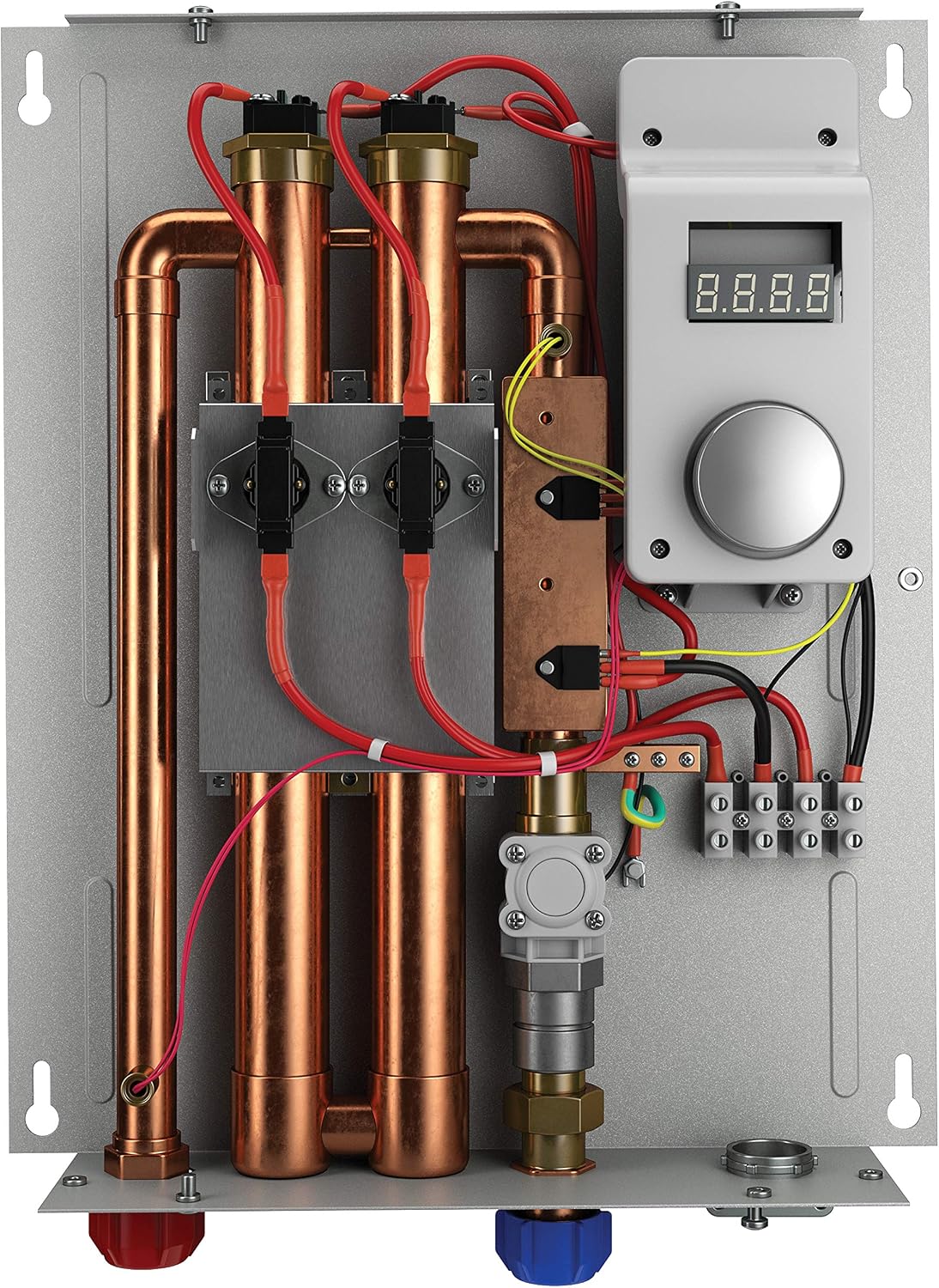
An electric tankless water heater heats water on demand — only when you turn on a tap — instead of keeping a tank of water warm around the clock. The 18–27 kilowatt (kW) range is the middle ground of that product category: powerful enough to handle a full shower in most of the continental U.S., not so large that it requires a panel upgrade in every home. Kilowatts measure how fast the unit can add heat to water passing through it. More kilowatts means more hot water per minute, or the same flow in colder groundwater conditions. That sounds simple, but the 18–27kW segment is where marketing claims and real-world output most frequently diverge. Some units carry an ETL or UL certification mark — meaning an independent safety lab has verified the electrical design — while others arrive with impressive-looking spec sheets that don’t survive a temperature-rise calculation. This guide cuts through that gap, names the tradeoffs explicitly, and gives you a decision framework you can apply to a purchase or spec decision right now.
| EDITOR'S PICK[Rheem 18kW 240V Tankless Electr…](https://www.amazon.com/dp/B01MR7Z39V?tag=greenflower20-20) | Mid-tier[EcoSmart ECO 18 Electric Tankle…](https://www.amazon.com/dp/B0047V0KSU?tag=greenflower20-20) | Budget pick18kW Tankless Water Heater Elec… | |
|---|---|---|---|
| Flow Rate | — | — | 4.3 GPM |
| Modulation | — | ✓ | — |
| WiFi Control | ✗ | ✗ | ✓ |
| ETL Cert. | — | — | ✓ |
| Price | $438.00 | $368.00 | $279.98 |
| See on Amazon → | See on Amazon → | See on Amazon → |
Why ETL Certification Is a Floor, Not a Crown
ETL Listed and UL Listed are both nationally recognized testing laboratory (NRTL) marks. The U.S. Occupational Safety and Health Administration maintains the NRTL program, and per the Intertek ETL Listed Directory, ETL certification verifies that a product’s electrical construction meets the applicable ANSI/UL safety standard — in this case UL 499 for heating appliances. What certification does not verify is thermal output accuracy. A unit can be ETL-listed and still overstate its usable flow rate at real-world inlet temperatures.
That distinction matters enormously in the 18–27kW tier. Per the U.S. Department of Energy’s consumer guide on demand-type water heaters, flow-rate ratings on tankless units are calculated against a specific temperature rise — typically 77°F for federal testing purposes. If your groundwater enters at 45°F in January (common in the mid-Atlantic, Great Lakes, and Pacific Northwest), you need roughly 36°F more temperature rise to reach 105°F at the showerhead than that standard assumes. A unit rated at 2.5 GPM (gallons per minute) on the label may realistically deliver 1.4–1.7 GPM under those conditions.
The spec-sheet inflators in this category exploit that gap. They publish a peak GPM at favorable inlet temperatures — 67°F or higher — without prominent disclosure. The ETL mark assures you the unit won’t burn your house down. It does not assure you it will fill a bathtub at a reasonable pace in February.
What to look for instead: Seek out manufacturers that publish flow-rate tables at multiple inlet temperatures (40°F, 55°F, 70°F) rather than a single peak figure. Stiebel Eltron, Eemax, and Bosch consistently publish multi-condition flow tables in their installation manuals, which are available through their respective product pages. Manufacturers who bury that data or omit it entirely are signaling something.
The 18–27kW Performance Band: A Honest Map
By the Numbers
| Rated Power | Approx. GPM at 40°F Rise | Approx. GPM at 55°F Rise | Typical Panel Draw |
|---|---|---|---|
| 18 kW | ~1.6 GPM | ~2.1 GPM | 75A @ 240V |
| 24 kW | ~2.1 GPM | ~2.8 GPM | 100A @ 240V |
| 27 kW | ~2.4 GPM | ~3.1 GPM | 112.5A @ 240V |
Temperature rise calculated using the standard formula: GPM = kW × 14.4 ÷ ΔT(°F). Panel draw assumes resistive heating at unity power factor.
That table does more decision work than most product pages will do for you. A 24kW unit at 40°F inlet — realistic for northern climates in winter — delivers just over 2 GPM. A standard 2.5 GPM showerhead runs fine; a rain-head at 2.5 GPM plus a simultaneous hand shower at 1.5 GPM does not. If you’re speccing for a primary bathroom in Minneapolis or Denver, the honest answer is that 24kW is a single-fixture solution in winter conditions, and 27kW buys you a modest buffer.
Where 18kW Actually Fits
The 18kW tier is often sold as a “whole-home solution” for mild-climate markets — Florida, coastal California, the Gulf Coast — where groundwater stays in the 65–72°F range year-round. In those markets, per the Department of Energy’s consumer guidance, an 18kW unit can genuinely support two simultaneous moderate-flow fixtures. North of the Mason-Dixon line in winter, 18kW is a point-of-use or single-bathroom solution. That’s a legitimate use case; it’s not a whole-home solution in Chicago.
The Stiebel Eltron Tempra 20 Plus (published at 20kW) and the Bosch Tronic 3000 series at comparable wattages are frequently cited in This Old House’s buying guide and Popular Mechanics’ review roundup as honest performers in this lower tier. Both publish multi-condition flow data and have long operator review histories that align with spec-sheet claims. Operators in long-run reviews consistently note that the Stiebel’s Advanced Flow Control — a feature that automatically modulates flow rate to maintain outlet temperature rather than delivering cold water — is the kind of real-world engineering that distinguishes the platform from cheaper alternatives that simply cut heating elements and drop output temperature.
Where 24–27kW Earns Its Place
At 24kW and above, you’re drawing 100 amps or more at 240V. That is not a trivial panel ask. Before any product conversation, the question is whether your existing panel and service entrance support the load — and whether your wiring run from panel to installation point can carry it within voltage-drop tolerance. The Eemax EEM24027 (27kW) and the Stiebel Eltron Tempra 29 Plus are frequently specified in this range for master bath and light-commercial point-of-use applications. Per Popular Mechanics’ roundup coverage, owners of the Eemax commercial-grade units report consistent thermal output alignment with published specs, which is the meaningful differentiator at this tier.
The ENERGY STAR program’s water heater specification document notes that electric resistance tankless units do not qualify for ENERGY STAR certification — the program sets its efficiency threshold at heat pump technology for whole-home electric water heating. That means no federal tax credit under the current Residential Clean Energy Credit pathway for straight-resistance tankless. If your decision frame includes incentives, that gap matters. The Rheem Prestige Hybrid Heat Pump, for instance, qualifies for up to $2,000 under the 25C tax credit as of the 2025 credit cycle; a 24kW resistance tankless does not, regardless of manufacturer.
The Five Spec-Sheet Red Flags to Catch Before You Buy
The spec-sheet inflator problem follows predictable patterns. Here’s the decision checklist:
1. Single-condition flow rating. If the product page shows one GPM number with no reference to inlet temperature, assume it’s tested at the most favorable condition (67–70°F inlet). Apply the formula above to your actual groundwater temperature and recalculate.
2. Absent or vague ETL/UL documentation. A legitimate ETL or UL listing includes a file number you can verify in the Intertek ETL Listed Directory or UL Product iQ database. “ETL-tested” or “ETL-approved” phrasing without a traceable file number is marketing language, not certification.
3. Panel amperage understatement. Some listings show a 24kW unit with a “60A” breaker recommendation. The math doesn’t work: 24,000W ÷ 240V = 100A, and NEC 210.19 requires continuous-load conductors sized at 125% of continuous load. If the panel recommendation doesn’t match the math, the spec sheet has an error — or is designed to obscure total electrical cost.
4. No modulation documentation. Better units in this tier — Stiebel’s Tempra Plus line, the Eemax commercial series — modulate element power to avoid cold-water breakthrough at the outlet. Entry-level units switch elements on and off in fixed increments, which can cause outlet temperature swings of 8–12°F. The installation manual or spec sheet should explicitly describe the modulation approach. Silence on this point is informative.
5. Warranty asymmetry. The heating elements in mid-tier electrics are consumable under hard-water conditions. A 5-year warranty on elements with a 1-year warranty on the heat exchanger is a red flag about where the manufacturer expects failures. Look for warranty terms that cover elements and heat exchanger at parity for at least 3 years.
The Decision Framework
If your groundwater is above 60°F year-round (Florida, Gulf Coast, Southern California) and you’re speccing a single primary bathroom: 18–20kW is sufficient and lowest installation cost. Stiebel Tempra 20 Plus or Bosch Tronic at this range have the operator-review history to back the spec sheet. Budget $600–$900 for the unit plus $300–$600 for electrical work if your panel is already adequate.
If your groundwater drops below 55°F in winter and you want reliable single-bathroom performance: 24kW is the honest minimum. The Stiebel Tempra 24 Plus and the Eemax EEM24027 are both supported by long owner-review records and multi-condition flow documentation. Budget $800–$1,200 for the unit. Panel upgrade costs are variable but plan for $800–$2,000 if your current panel is at capacity — that cost often determines the actual decision.
If you’re evaluating electric tankless for a master bath with a rain-head configuration, or a light-commercial point-of-use application with simultaneous draw: 27kW is the floor and multiple-unit parallel configurations may be more practical than a single oversized unit. Two 18kW units on separate circuits, each serving one fixture cluster, gives you redundancy and installation flexibility that a single 27kW unit cannot. Eemax’s commercial-grade series is specifically designed for this configuration and is rated for the application.
If federal or state incentives are part of your ROI calculation: straight-resistance electric tankless does not qualify under ENERGY STAR’s current water heater threshold, per the ENERGY STAR key product criteria document. Route those buyers toward heat pump water heater options before they discover the incentive gap after installation.
The certification mark is the safety floor. The multi-condition flow table is the performance contract. The panel math is the installation reality check. Any unit that can’t clearly show you all three is asking you to take on the risk of that ambiguity — and in this tier, that’s a risk you don’t need to accept.