If you’ve ever stood in a cold shower while a family member ran the dishwasher, you already understand the core problem this article solves. A tankless water heater — sometimes called an “on-demand” heater — heats water only when you need it, with no storage tank that can run empty. But “tankless” doesn’t automatically mean “unlimited.” Each unit has a maximum flow rate measured in gallons per minute (GPM) — the volume of hot water it can produce per minute at a usable temperature. Buy a unit with too low a GPM rating for your home’s real demand, and you’ll get lukewarm water the moment two fixtures run at once. This guide walks you through calculating your actual GPM requirement, explains why condensing gas models (which recapture exhaust heat for extra efficiency) are the sweet spot for whole-home use, and gives you a clear comparison of the leading units so you can commit with confidence.
Why Condensing Matters for Whole-Home Sizing
Before getting into the GPM math, it’s worth understanding what “condensing” actually does for you — because it changes the sizing calculus in a meaningful way.
A standard (non-condensing) gas tankless unit vents hot exhaust gases straight out through the flue. That waste heat represents efficiency losses — the Department of Energy’s consumer guidance notes that non-condensing gas tankless units typically achieve Uniform Energy Factors (UEF, the standardized efficiency rating replacing the older EF metric) in the 0.82–0.87 range. A condensing unit adds a secondary heat exchanger that captures latent heat from those exhaust gases, extracting it before venting. The result: UEF ratings typically in the 0.90–0.96 range, and crucially, more BTU output actually transferred into your water per therm of gas consumed.
For whole-home sizing, that efficiency gap translates directly to available GPM at a given gas input. Two units with identical BTU burner ratings can produce meaningfully different hot water flow rates if one is condensing and one isn’t. Per ACHR News coverage of whole-home tankless sizing, contractors consistently report that condensing units deliver 10–15% more usable hot water from the same gas supply than comparable non-condensing competitors — which matters when you’re trying to squeeze performance out of an existing ¾-inch gas line.
The secondary benefit is ENERGY STAR certification. Per the ENERGY STAR Program Requirements for Residential Water Heaters (Version 4.0), gas condensing tankless units meeting the 0.87 UEF threshold qualify for the ENERGY STAR label, and many exceed it — making them eligible for federal tax credits under the Inflation Reduction Act’s Section 25C provisions (verify current credit amounts at energystar.gov, as annual caps and eligibility rules update).
The GPM Calculation You Actually Need
The single most common mistake in tankless purchasing is trusting the box’s marketing headline (“Up to 11 GPM!”) without understanding what that number means at your incoming water temperature.
Manufacturers rate GPM at a specific temperature rise — usually 35°F or 45°F. If your groundwater comes in at 40°F in January (common in northern climates) and you want a 120°F shower, you need a 80°F temperature rise. At that demand, a unit rated “9.5 GPM at 35°F rise” might deliver only 5–6 GPM in practice. This is the sizing trap that generates the most owner complaints in aggregated reviews across This Old House and Popular Mechanics.
Here’s the practical sizing method:
-
Find your incoming cold water temperature. The ENERGY STAR program and most utility databases publish average groundwater temperatures by ZIP code or climate zone. Northern states (Minnesota, Maine, Michigan): often 37–45°F in winter. Southern states (Texas, Florida): 60–70°F year-round.
-
Set your desired output temperature. 120°F is the standard for residential use (and the recommended anti-scald minimum per most plumbing codes). Some households set 110°F; commercial kitchens often require 140°F.
-
Calculate your peak simultaneous demand. Add up the flow rates of every fixture that might run at the same time. A standard shower runs 1.5–2.5 GPM; a kitchen faucet, 1.5–2.0 GPM; a dishwasher, 1.0–1.5 GPM; a bathtub fill, 3.0–4.0 GPM. A family of four with two bathrooms, a kitchen, and a laundry hookup can realistically need 6–8 GPM at peak.
-
Look up your target unit’s GPM at YOUR temperature rise. Every reputable manufacturer publishes performance tables in their spec sheets — not just the headline number, but output at 35°F, 45°F, 55°F, 70°F, and 80°F rises. Use that table, not the box front.
By the Numbers: GPM at Different Temperature Rises (Representative Condensing Units)
| Unit | Rated Input (BTU/hr) | GPM @ 35°F Rise | GPM @ 55°F Rise | GPM @ 80°F Rise |
|---|---|---|---|---|
| Rinnai RUR199iN | 199,000 | ~11.1 | ~7.7 | ~5.4 |
| Navien NPE-240A2 | 199,900 | ~11.2 | ~7.7 | ~5.3 |
| Rinnai RUR160iN | 160,000 | ~8.9 | ~6.2 | ~4.3 |
| Navien NPE-180A2 | 180,000 | ~10.0 | ~6.9 | ~4.8 |
Values derived from published manufacturer spec sheets. Always verify against the current model’s performance table before purchase — manufacturers update specs with production runs.
If you’re in a northern climate with 40°F groundwater and targeting 120°F output, you’re operating at an 80°F rise. That “11 GPM” headline on the Rinnai RUR199iN becomes approximately 5.4 GPM in real conditions. For a household needing 6–7 GPM peak, that means either: (a) two units in parallel, (b) accepting some demand management, or (c) recognizing that a warm-climate buyer has far more headroom with the same hardware.
Head-to-Head: The Four Units Worth Specifying
For the whole-home condensing gas segment, four models consistently surface in trade contractor discussions and owner review aggregations as the serious contenders in the $900–$1,400 installed range.
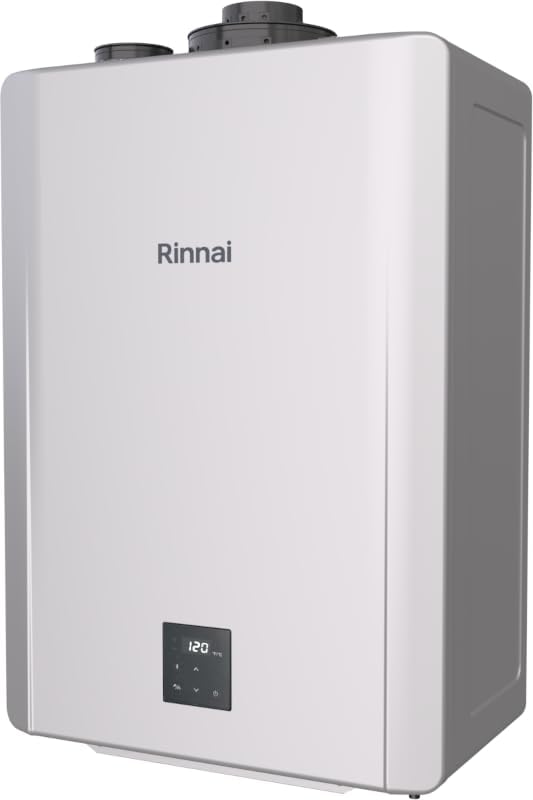
Rinnai RUR199iN
The Rinnai RUR Series is the unit most frequently specified by plumbers in ACHR News-covered contractor surveys. The RUR199iN uses Rinnai’s ThermaCirc360 built-in recirculation pump — no external pump required, no dedicated return line needed when using the comfort connector accessory. Owners consistently report fast hot water delivery and stable temperature modulation across partial loads, which is where cheaper units fluctuate. The unit supports Rinnai’s Control-R 2.0 app for scheduling and monitoring.
Tradeoff to name explicitly: the venting configuration requires either PVC (up to 2-inch for shorter runs, 3-inch for longer) or stainless Category IV — the condensate drainage requirement catches first-time condensing installers. The install cost premium over a non-condensing unit is real; budget $200–$400 more for the condensate neutralizer and drain line rough-in.
Navien NPE-240A2
The Navien NPE-240A2 is the direct competitor to the RUR199iN and the unit This Old House’s buying guide coverage consistently highlights for its NaviLink Wi-Fi integration and ComfortFlow built-in buffer tank (0.8 gallons). That buffer tank solves the “cold water sandwich” problem — a brief slug of cold water that occurs when a tankless unit fires on short draws — more elegantly than competing designs. Spec sheets put the NPE-240A2 UEF at 0.96, among the highest in class.
Tradeoff: the buffer tank adds a small amount of standby loss (minimal, but nonzero), and the unit is physically larger and heavier than the Rinnai. Service technicians familiar with Rinnai may need factory training on Navien’s error code architecture, which is more granular (and initially confusing to read).
Rinnai RUR160iN
If your gas line is ¾-inch and upgrading to 1-inch supply isn’t in the budget, the RUR160iN at 160,000 BTU/hr may be the honest choice rather than overpromising a 199,000 BTU unit that the gas supply can’t feed at full demand. Per manufacturer gas pressure requirements, the 199,000 BTU units need verified static and dynamic pressure at the unit — undersupply here causes nuisance shutdowns at peak load. The 160iN trades some peak capacity for reliability on constrained gas lines in warm and moderate climates.
Navien NPE-180A2
Same logic on the supply side as the RUR160iN, but with Navien’s buffer tank design. The NPE-180A2 is the appropriate spec for a 3-bedroom home in a moderate climate (55–60°F groundwater) where peak simultaneous demand realistically caps at 5–6 GPM. Trying to run an NPE-240A2 on undersized gas just buys you a more expensive unit that throttles anyway.
Installation Variables That Change the Outcome
Two factors beyond the unit itself will determine whether your GPM math actually holds in the field.
Gas line sizing. The 199,000 BTU units require sufficient gas pressure and flow at the appliance. The International Fuel Gas Code (IFGC) tables — referenced in the 2021 IRC and adopted or amended by most state codes — specify pipe diameter, length, and pressure drop calculations. A ¾-inch line may be adequate at 30 feet from the meter but inadequate at 60 feet, especially if other appliances share the run. Have your installer pull actual dynamic pressure readings at the unit location before finalizing the spec. Undersized gas supply is the most common reason a properly sized condensing unit underperforms.
Incoming water temperature seasonal variation. Groundwater temperatures follow a seasonal curve with a 6–8 week lag behind air temperatures. A unit that comfortably covers your family in August may fall short in February. If your climate zone has winter groundwater below 45°F and your peak demand is near the top of the unit’s rated capacity, size up one tier or plan for demand management (stagger appliances, install a small buffer tank, or add a point-of-use unit at the most remote fixture).
The Decision Rule
If your peak demand is under 5 GPM and your groundwater stays above 55°F year-round, a mid-tier condensing unit like the Navien NPE-180A2 or Rinnai RUR160iN will cover your home without requiring gas line upgrades — and at a lower installed cost.
If your peak demand is 5–8 GPM or your groundwater drops below 50°F in winter, spec the Rinnai RUR199iN or Navien NPE-240A2. Both are rated near the top of residential capacity, and the ENERGY STAR qualification means you can stack manufacturer rebates with potential federal Section 25C tax credit and utility rebates — check your utility’s current program at energystar.gov’s rebate finder. The installed cost difference over a smaller unit typically recovers within 18–36 months on fuel savings alone in high-usage households, per the Department of Energy’s demand water heater cost modeling.
If your gas supply is the binding constraint, solve that first — or match the unit’s BTU requirement to what the line can actually deliver. A condensing unit throttled by gas starvation is no better than the non-condensing unit it replaced.
Get the groundwater temperature, calculate your real peak GPM, then pick the unit whose spec-sheet output at your temperature rise meets that demand with a 10–15% margin. Everything else — Wi-Fi integration, recirculation design, buffer tanks — is a tiebreaker. GPM at your temperature rise is the number that matters.